A couple of years ago I stumbled across a little family cemetery in the middle of a cornfield out in the farming country between Shippensburg and Newville, not far from the Rail Trail. I went back last Wednesday to get some better shots than I got when I first found the place; here they are.
The Smith family plot on Smithdale Road, smack in the middle of a corn field
A well-carved stone
An interesting stone. Unfortunately the first name is weathered beyond legibility
This week's walk in the Dykeman Spring Nature Park was very pleasant indeed. The temperatures have begun to moderate, and there was a gentle breeze to add to the atmosphere. Summer seems to be winding down a bit, but Autumn hasn't yet shown its face. Still, there were a few things to please the eye today.
I got this candid shot of a sunning Painted Turtle before it noticed me and slid into the water
Hooray! Winterberries! For some reason they didn't develop last year
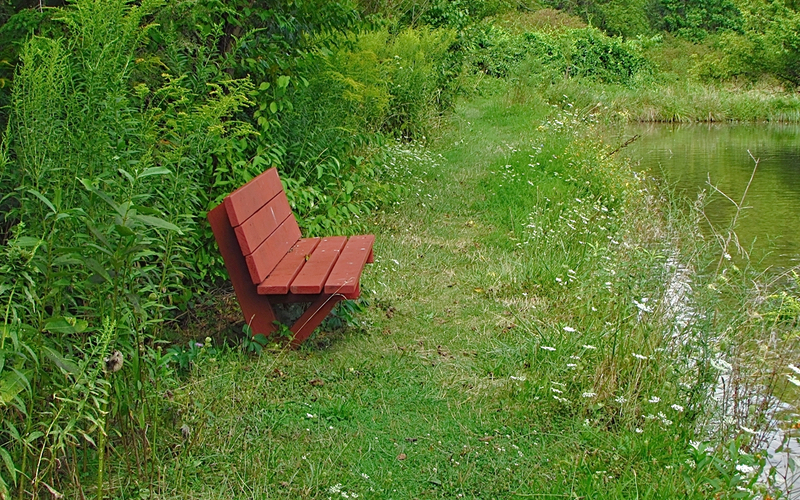
My serenity spot, sitting on the bench under the Kentucky Coffee Tree and contemplating the north duck pond
Bach wrote three cantatas for the twelfth Sunday after Trinity, and I've chosen his final one this week - BWV 35, Geist und Seele wird verwirret (Spirit and soul become confused, Leipzig 1726). This is a solo cantata for alto voice, and what's unique about it is the fact that much of the music is borrowed from other pieces he composed, and most of the sources he borrowed from are now among the "lost" Bach catalog. So this cantata is, in a way, is the survival of all those lost pieces! Here's musicologist Simon Crouch on this cantata:
The solo alto cantata BWV 35 gets such a high rating from me
primarily because of its oddity value! It becomes rapidly apparent upon
listening to this work that almost all of it has been filched from other
sources. Since almost all of those other sources are lost to us, we get
a deeply valuable view of what might have been. The first few bars of
the opening sinfonia agree with the nine remaining bars of the otherwise
lost keyboard concerto BWV 1059 (itself possibly derived from a lost
oboe concerto) and it's a reasonable bet that two of the other movements
of this cantata are derived from other movements of the concerto. The
first aria, a lilting siciliano, may very well come from from
the slow movement of the keyboard concerto and the opening sinfonia of
part 2 of the cantata is probably from the finale of the concerto. In
this incarnation the organ gets the solo part. So, at the very least we
probably have most of a lost concerto sitting inside this cantata.
Fortunately there is enough left here to reconstruct the concerto and
several recordings are avalable that allow us to enjoy this fine work.
The second aria from part 1 of the cantata sounds as though it's adapted
from a cello or gamba sonata and the final aria in part 2 suggests a
violin concerto. (Again, throughout, the organ takes on the obbligato
part). Both of these movements are very attractive and thus point to a
considerable loss.
Having heaped all this praise upon the components of this cantata,
I think that it's fair to tilt the balance the other way a little and
say that, as a cantata, this is not a great work. The libretto (based on
the gospel of the day) is nothing special and the structure of the
composition as a whole feels rather unsatisfactory. (Great Heavens,
there isn't even a concluding chorale!) So, listen to this for the music
that we nearly lost.
We had something of a fierce downpour early this morning, so today's walk in the Dykeman Spring Nature Park was another wet one. There are definitely signs of approaching Autumn; the late Summer flowers are blooming, especially the Spotted Jewelweed and the Yellow Ironweed. And I saw two female Ruby-throated Hummingbirds flitting about in the wetland; the males leave for the trip south first, and the females hang around until just around now before they head off. I didn't get their pictures; they never settled, and my reflexes, especially with a long lens in low light, aren't fast enough to catch them in flight. But I got some decent shots of other things.
Spotted Jewelweed, also known as Spotted Touch-me-not, with a raindrop
The Yellow Ironweed is starting to bloom; this cluster had some visitors
Leaves sprouting out of a debris-filled knothole
A creeping vine and old wood
More rain on the way - looking north from the top of the meadow
Bach wrote three cantatas for the eleventh Sunday after Trinity, and for today I've chosen his first one, BWV 199, Mein Herze schwimmt im Blut (My heart swims in blood, Weimar 1714). The text is somewhat grim, but the music is absolutely beautiful. It's a solo cantata for soprano, so you'd think it would get somewhat monotonous after a while, but Bach's instrumental accompaniment makes up for that lack of vocal diversity, and then some. Here's the late Craig Smith of Emmanuel Music on this beautiful work of art:
The texts of Georg Christian Lehms are the most extreme,
self-flagellating texts ever set by Bach. Of all of his texts, the one
for BWV 199 is perhaps the bloodiest. This is one of those texts that,
if it weren’t set with such penetration and sincerity that one could not
take it seriously. It has, however, generated one of the great Bach
cantatas that is almost unique in its intensity and passion. The work
was only known in fragments, and was published that way in the old Bach
Gesellschaft until it was discovered whole by the Danish scholar
Matiennsen early in the twentieth century. Since then four versions of
the piece have come to light.
The work has many distinctive features. Most immediately
striking is the new and flexible recitative style. The three
accompagnato recitatives are especially advanced; being genuine
accompanied recitatives with flexible speech rhythms in the voice part
and rather neutral, non-motivic string parts. The old quasi-arioso kind
of recitatives of the Buxtehude type that we have seen up to this time
are replaced here by something much more operatic. Certainly the
intensity of the text has something to do with this, but also the new
discipline and organization of the aria forms demands something freer
and more contrasting in the recitatives. It is interesting that Mozart
several generations later went through this same process in his operas.
The elaborate ariosos of Idomeneo were replaced by much drier and more
musically perfunctory recitatives in Figaro.
The first few lines of text in the opening recitative are a
good example of Bach’s new found freedom. While the first several
phrases have some melodic profile, it is tied to the sense of the words.
(The little turn on the word schwimmt” the augmented sixth on the word
“sünden”) Each phrase, both in its length, but here almost more
importantly, in its range is autonomous. The strings provide a rigorous
tonal context for the wide-ranging recitative but no melodic profile.
When the intensity and direction of the ideas becomes fully formed, the
music goes into a rigorous aria form. In both of our arias here, that
form is a da capo, one that is not so common in the earlier Bach
cantatas.
The second aria with oboe obbligato is one of the first great
oboe arias. The wonderful and inspired associative logic of the material
in the first ritornello is so natural that one must be reminded that
this style is still relatively new to Bach. While all of the musical
ideas, the “sighing” in the word ”seufzer” and the hollow open fifth on
the word “stumme” generate from the text, there is a structural rigor
that is, of course not present in the recitatives. Bach has taken from
the world of opera the idea that a recitative is perfect for random
thoughts and the aria is the perfect form for the time when these
thoughts become organized. The aria has an interesting feature that the
end of the B section degenerates into a secco recitative only to be
brought back into control by the da capo.
The second accompagnato has a certain rigor at the cadences,
not found in the first that very much sets up the sense and sound of the
following aria. While the first aria has a kind of soaring almost
keening quality, the second aria is melodically almost a mirror
opposite. The huge opening ritornello of twenty four bars shows Bach
reveling in his new-found structural control. Two or three years earlier
he would not have even attempted such an edifice. The B section ends
with a striking foray into the subdominant giving the whole movement a
kind of vulnerability and softness that is a perfect setup for the
denouement of the introduction of the chorale.
The chorale movement is the section that underwent the most
changes in the various versions of the cantata. The obbligato is written
variously for viola, cello, viola da gamba and violoncello piccolo. The
first version, for viola, is the one most often heard today. It is the
most simple melodically and has none of the ornamental detail of the
later cello version. Martienssen’s published version with the cello
changes incorporated into the viola part is a good solution. As with
the best of Bach’s pieces in this genre, the obbligato is a wonderful
catchy tune, here based upon the first few notes of the chorale. It’s
marvelous open-hearted quality is a relief after the inward looking
intensity of the first two arias.
The final aria with oboe and strings is introduced by another
accompagnato. The aria is a da capo but is so brief that it is hard to
make work as a closing movement. Particularly odd is the lack of a
closing ritornello. There is something to be said for playing again the
opening nine bars at the end of the piece to provide a fitting
conclusion.
Today's performance is by the English Baroque soloists and soprano Magdalena Kožená under the direction of Sir John Eliot Gardiner in St. David's Cathedral, Wales, in 2000. Enjoy!
"It's a dangerous business, Frodo, going out your door. You step onto the
road, and if you don't keep your feet, there's no knowing where you
might be swept off to." — J.R.R. Tolkien
I had an errand this morning, to pick up a refill at the pharmacy. Since that's across town, I figured I'd use the walk to assess the possibility of wandering about a bit after the pick-up. At the time it was heavily overcast, mild, and very humid; it felt, and looked, like rain was imminent. But after picking up my refill I decided to go another 100 yards up the road to where it crossed Burd Run to see how the creek looked. And on the way I discovered a path that ran beside a cornfield and led directly to one of my favorite local wetlands; I'd discovered the "back door" to the Brookside Ave. wetland, leading right to the collection pond.
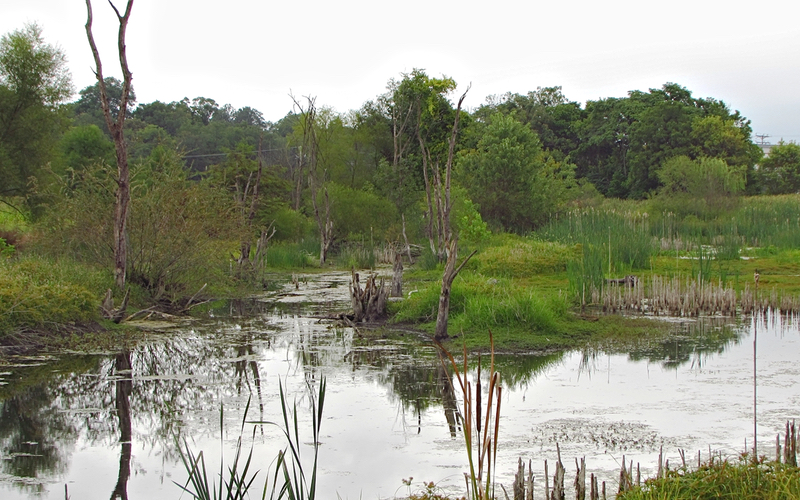
I haven't been to Brookside since the end of April, when I discovered that two years of frequent rain had filled the pond right to the brim of the berm around it (see the post about it here). Since then both July and August have been much drier, and the collection pond has sunk back a good bit from its previous level. What has emerged from that is something that looks like a swamp more than a pond, and a vibrant, lively swamp at that. The water level is still such that everything is well irrigated and lush, yet there's enough land above water to support a thriving plant and animal population. For me it was beautiful, truly a land of enchantment.
The quality of light this morning added to that sense of enchantment, and was perfect for photography. The heavy overcast made the colors more vibrant, and I had little to do in processing on the computer - just cropping and a little lightening of the darker shadows. So what you see in the following photos is pretty much as I saw it with the naked eye walking there this morning.
See, this is why I always carry my camera with me whenever I go out the door. You never know what will happen once you step out on the street, even on the simplest errand. Bilbo's warning to Frodo, quoted at the top of this post, is true!
It's still Summer, and I'm sure there's more hot weather coming, but since Friday we've been experiencing a hint of the coming Fall - much cooler and drier air. And what a pleasure it is to walk around in it. Dykeman Park certainly perked up, although the insects were a bit slow moving after the cool overnight and morning. Here are some scenes from this morning's walk.
An Appalachian Brown along the Dykeman Walking Trail
A drowsy Bumblebee on some Goldenrod along the trail
Bach wrote three cantatas for the tenth Sunday after Trinity, and today I've chosen the last one he wrote for that Sunday - BWV 102, Herr, deine Augen sehen nach dem Glauben! (Lord, thine eyes are looking for faith!, Leipzig 1726). The theme is the unrepentant sinner from the Gospel reading of the day, Luke 19: 41-48, and the mood of the music is both somber and reflective. Here's Brian Robins of All Music on this cantata:
Cantata No. 102 ("O Lord, are not thine eyes upon the truth") is a
sacred cantata for the tenth Sunday after Trinity. It was first
performed in Leipzig on August 25, 1726, a year that witnessed the
largest number of new cantatas (twenty-three or twenty-four) composed by
Bach
after the intense activity of the first two cantata cycles dating from
1723/4 and 1724/5. The text is taken from a series believed to have been
written by Ernst Ludwig, Duke of Saxe-Meinigen sometime before 1704,
when they were set by the Duke's Kapellmeister Georg Caspar Schürman.
Six other Bach cantatas are drawn from the same source. The early date
of these cantata texts places them in the vanguard of the so-called
"reform cantata," which introduced recitatives and arias set to free
poetic texts, an important change from the Biblical texts formerly
employed. The theme of Cantata No. 102 is that of the unrepentant
sinner, the topic of the Gospel of the day (Luke 19:41). Like a number
of Bach's cantatas, it is divided into two halves to be performed either
side of the sermon. It opens with a large-scale chorus scored for SATB
with an orchestral accompaniment for two oboes and strings. Employing a
text taken from Jeremiah 5:3, it is in three distinct sections, linked
by the return of the opening orchestral introduction at the end of each.
Bach subsequently adapted the chorus as the Kyrie of the Lutheran Mass
in G minor, BWV235. A bass recitative leads to the first aria for alto
accompanied only by solo oboe and continuo, another movement later
adapted by Bach, this time for the "Qui tollis" section of the Mass in F
major, BWV233. The first part of the cantata ends with an arioso for
bass based on words form Romans 2:4-5, "Despisest thou the riches of His
goodness and forbearance?" the da capo structure enabling the question
to be repeated at the end and lead straight into the sermon, an example
of the close integration between cantata (which might be viewed as a
musical sermon) and spoken sermon. The latter part of the cantata is
brief, consisting of only a tenor aria accompanied by solo flute, an
accompanied recitative for alto (with two oboes) and a chorale based on a
Lenten hymn which underlines the stern message of the cantata--"Today
livest thou, today convert thyself, before tomorrow comes." Few of
Bach's cantatas were published during his lifetime. Cantata No. 102 was
one of a group of three (No's 101 - 103) published in 1830, the first to
appear in print after Bach's death, thus playing an important role in
the nineteenth-century revival of his music.
Today's performance is from a recording by the Amsterdam Baroque Orchestra and Choir under the direction of Ton Koopman. Enjoy!
I'm off again today, and it's a typically hot and humid August day, so what better way to deal with it than to visit the shady spots along Branch Creek as it winds through town. I hope this cools you off as much as it did me!
Looking south on the King Street bridge by McLean House
Looking north from the same bridge, by the public library
Looking south at a spot next to the police station
Looking north from the same spot
Looking south from the gravel bar by the municipal park's playground
Looking north from the little concrete bridge behind the former Hoffman Mills
My work schedule has been all jumbled up due to new hires and continuing associates starting back to school, so at least for this week I have Sunday off once again. And we're in the midst of another blast of heat and humidity, making walking outdoors an uncomfortable proposition at best. But as long as I have free time and my camera, nothing will keep me indoors on my day off. So here are some scenes from this week's walk in the park.
A Monarch on a Milkweed pod
Boneset along the Dykeman Walking Trail
Part of the path around the north duck pond
Meanwhile, up on the meadow, my friend Wade is getting the second haying of the season done
I found this impromptu little bouquet of Daisy Fleabane near the eastern end of the meadow
High humidity + a hot August sun = castles in the sky
Today's Bach cantata is a real treat! Of the three cantatas he wrote for the ninth Sunday after Trinity, this one is considered one of Bach's great masterpieces - BWV 105, Herr, gehe nicht ins Gericht mit deinem Knecht (Lord, do not pass judgement on your servant, Leipzig 1723). The theme of this cantata is redemption; the opening chorus is a setting of the second verse of Psalm 143 (Enter not into judgment with your servant, for no one living is righteous before you.) and goes on to examine the parable of the unjust servant, Luke 16: 1-9. The music follows the mood of the text very dramatically. Here's what musicologist Simon Crouch had to say about this marvelous work:
There are two essays concerning Cantata 105 in Robert Marshall's collection of essays The Music of Johann Sebastian Bach. The first The Autograph score of Herr, gehe nicht ins Gericht
describes what we can deduce from the autograph about Bach's composing practice and the second The Genesis of an Aria Ritornello attempts to "get inside the composers head" while he's composing the first aria Wie zittern und wanken.
They both make for fascinating reading. The most astonishing deduction
is that of the speed with which Bach was able to compose this
masterpiece. Marshall's analysis suggests that the score was completed
within two or three days!
Masterpiece it is. This is one of those "perfect" cantatas where
there is a wonderful text exactly allied with excellent music. The mood
is contemplative and reflective, meditating on the meaning of Christian
faith. The opening chorus is a prelude and fugue, taking as text the
second verse of psalm 143. The first sentence is accompanied by a
sighing, lamenting theme and the second sentence is a magnificent choral
fugue. I would love to sing this one! The first aria, which follows a
recitative, is beautifully balanced over a trembling viola/violin line: How tremble and waver the sinners' thoughts, while they accuse one another and again dare to excuse themselves. Following a lovely bass arioso, there is a change of mood in the driving, optimistic tenor aria If I can only make a friend of Jesus, Mammon is worth nothing to me.
Even the closing chorale receives extra special attention from Bach.
That's really the feeling that I'm left with, that Bach paid extra
special attention when composing this cantata, inspired by an
outstanding text.
Today's performance is from a recording by the Chorus and Orchestra of the Collegium Vocale of Ghent under the direction of Philippe Herreweghe. Enjoy!
This week's walk in the Dykeman Spring Nature Park was full of butterflies and late Summer flowers, so the camera moved in for some up close and personal shots this morning.
A Black Swallowtail in the Joe Pye Weed by Gum Run
Dogwood berries along the Dykeman Walking Trail
The Spotted Jewelweed is blooming in the wetland
New York Ironweed in the wetland
A Tiger Swallowtail on Spotted Knapweed by the north duck pond
A Variegated Fritillary enjoying the Red Clover up on the meadow
Bach wrote three cantatas for the eighth Sunday after Trinity, and today I've chosen his first one - BWV 136, Erforsche mich, Gott, und erfahre mein Herz (Search me, God, and learn my heart; Leipzig 1723). Today it's sunny and mild here in Central PA, and this cantata matches that sunny mood perfectly. You'll definitely dance through this one! Here's the late Craig Smith of Emmanuel Music on this cantata:
The subtle and marvelously colored chorus that begins the cantata is
typical of the extreme care that Bach took with his texts. The two
operative words here are "erforsche" (to examine) and "prüfe" (to
prove). The beautifully meandering wind and string lines literally
examine the harmony of the opening. The passionate and beautiful
syncopated chords on the words "to prove" are the logical result and
extension of that examination. The extremely high and exotic horn
writing adds to the otherworldly beauty of the movement. It is not the
celebratory or commemorative, ‘trumpets and drums’ sort of festive
proclamation, rather an open, carefree, perhaps almost teasing
invitation----come, search me and know my innermost thoughts.
The tenor recitative, essentially a rant against hypocrisy, is so laden
with metaphor that it can be confusing to read on the page. However,
Bach’s two part structure makes it very clear. The alto aria with oboe
d’amore is so spare it at times sounds as if there is a part missing.
The cool, walking bass becomes almost hypnotic and the aria, as the
central movement of the cantata, turns out to be a frightening picture
of the last judgment when sentence shall be passed and hypocrisy will
tremble and be destroyed under His zeal. The aria is unusually
constructed, a presto middle section portraying the enthusiastic
destruction of guile enclosed by more measured and sober outer sections.
The bass recitative ushers in the main theme of the cantata to beware of
false prophets. The bass and tenor voices combined with the manic,
insistent violins create a vivid and frightening portrait of those false
prophets. The repetitive wailing of the voices about the fall of Adam
is haunting and in the end amazingly ambiguous in its tone. A
harmonization of Wo soll ich fliehen hin with the first violins playing an obbligato fifth voice ends the work grandly.
There was something formless and perfect before the universe was born. It is serene. Empty. Solitary. Unchanging. Infinite. Eternally present. It is the mother of the universe. For lack of a better name, I call it the Tao.
It flows through all things, inside and outside, and returns to the origin of all things.
The Tao is great. The universe is great. Earth is great. Man is great. These are the four great powers.
Man follows the earth. Earth follows the universe. The universe follows the Tao. The Tao follows only itself.
Tao Te Ching, Chapter 25 Translation by Stephen Mitchell
Great Lumps Of Stone
-
The ancients took great lumps of stone and stacked them in monumental piles
to praise the gods. The Egyptians took great lumps of stone and stacked
th...
Sunk without a trace
-
I got an email this morning to let me know that a new critique of Cronin
was recently published. Maybe I’m just getting old, but I blinked and
thought, “Hu...
𝐧.𝐛. 𝐚𝐧 𝐨𝐥𝐝 𝐩𝐡𝐨𝐭𝐨 𝐨𝐟 𝐦𝐞 𝐨𝐧 𝐇𝐨𝐥𝐲 𝐈𝐬𝐥𝐚𝐧𝐝 𝐢𝐧
𝟐𝟎𝟎𝟒
-
Just a brief Health Update . I've been having tests/scans/biopsy's etc for
over 12 months now It's been 3 months since my biopsy in Bradford and
,apart fr...
Cloud Pond Sky River – coming soon
-
I have finished a new 60 minute quiet piece, which I plan to release on
October 30, only on Bandcamp
The post Cloud Pond Sky River – coming soon appeared...
Hegseth Gaslighting Word Salad
-
SECRETARY HEGSETH: Well, unnecessary word good morning.
We just <— red flag word, either say when if it’s important or delete finished
an update with ...
An Announcement
-
In a couple of months, we will reach the 10th anniversary of this blog. I
started the blog a few days after I retired at the age of 67 and began a
new life...
Ninety Years Ago Today...
-
Ninety years ago today, he was born.
He was -- arguably -- one of the greatest entertainers *ever*.
He has been --* in*arguably -- one of the biggest ...
#WhatcanIdo Wednesdays
-
In an attempt to compromise between saying nothing and saying everything
(with fury and outrage), I’m going to post once a week: a series of citizen
respon...
End of the Road for Google Drive in Transmit
-
We never like removing functionality from our apps. We especially don’t
like doing it when it’s due to circumstances beyond our control. But,
sometimes — r...
Roger Ailes
-
Roger Ailes Anonymous (not verified) Tue, 10/01/2024 - 21:31
Share on Facebook Share on X Share via Email Copy link
Copied to clipboard
Name
Roger Ailes
Mad as hell
-
So there I was, arm hooked up to the machine, watching my plasma swirl away
into a bag while the morning news dribbled across the screen like a bad
feve...
2/24/23 Rest of Life Newsletter
-
Emerging from a place of deep peace, expansiveness and renewal, Rest of
Life is Steve Roach’s new 134-minute opus to quietude. With a graceful,
nurturing q...
NEW BLOG SITE
-
Hello, This is to announce that as of today, this is no longer the site of
the active Tom the Dancing Bug Blog. The Blog has moved to
https://tomdbug.wpcom...
Visit the Internet Monk Archives
-
20 Years of Internet Monk For twenty years, Michael Spencer, Chaplain Mike
and a number of other writers described and discussed the post-evangelical
life,...
The heronry is open for business!
-
On January first Matty and I decided to explore the woods beside our house
and see what was there. The woods lead into a protected green space we had
never...
Things at Your Bird Feeders are a-Changin’
-
Not more than a week ago, our bird feeders were almost abandoned. We’d see
doves (4 or so), chickadees (4 or so), 1-2 cardinals at dawn and dusk, and
littl...
Zion
-
The National Parks of Utah have long been on my bucket list so I was
overjoyed when I finally reached the park entrance to Zion!
I knew the landscape wo...
Twice the Man is OUT!
-
My Bete novels are among my best received. Not because they're sort of but
not entirely YA while still appealing to adults (and I've had almost no one
b...
Dial for a Cause
-
* and put a scammer to good use * ==================
Don't want to give a scam person/website your phone #? Give them a real #,
but one that helps a cause...
Prostate Diary: Finding Out
-
Last May, while walking across the corporate campus where I work, the
physician's assistant at my doctor's office called to tell me that I had an
elevate...
After Lunch
-
*After Lunch*
after the meal: doze off for one nap;
waking, it’s time for two bowls of tea—
raise my head to gaze at the sun; it’s
already turned southwes...
La La La La Land
-
You know, it's almost Academy Award time again and yes, VE watches every
minute of the self-congratulatory mayhem with popcorn in hand!
It also means I'm i...
West Wing Week 1/19, or "Obama, Farewell"
-
On our last, full day here at the White House, here is the Obama
Administration's 388th -- and final -- episode of our weekly round-up
video, West Wing W...
Quote of the Day
-
"You can't acheive what you don't believe. Put an end to focusing on
negative implications and finally see the positive possibilities." -Mark
Batterson
Theme Thursday for September 29, 2016 - ANTS
-
*ANTS *
*This weeks new theme is ANTS!*
*Tis the season for the ants!*
*Ants, ants, ants, everywhere!*
*Where did all these ants come from?*
*Invasion of...
Music outside the box
-
Living in Boston puts me in the middle of a vibrant stew of music. The
greater Boston area has more music venues, more musicians, more music
schools than a...
Cenotaph
-
This place marks
a superb spot,
where everyone expects
me to reside,
to germinate undisturbed,
dispassionate, deep.
They do not know
it is an empty...
The Caffeine in Your Tea Cup
-
As a tea importer, my daily cup is almost always a nice, soothing tea
blend, brewed nice and hot. However, here in the US a much greater
percentage of pe...
People Who Live in Glass Houses: Carly Fiorina
-
I watched an interview with Carly Fiorina on "Morning Joe" today. She is a
person of interest to the press as they fully expect her to announce she's
runn...
Finished Commission - and Thoughts
-
I was reminded yesterday by an online friend that my blog is suffering from
neglect! Yes, it's true. As I have worked to get a presence on FB, Etsy,
Arts...
Housekeeping and A Little Bit of Everything Else
-
There are two things I find myself saying every day: take that off the
table and I still need to do that.
Last year I lost two big writing contracts, one ...
When Will It Stop?
-
Eric Garner. Michael Brown, Akai Gurley. When. Will. It. Stop?
I drew these cartoons a long time ago, but seems like the story is always
the same.
And ...
The People You Meet
-
Not saying this is a come back of any type, but after farewelling my
darling friend Jeffrey today, I felt the overwhelming need to blog. Met a
weird Japan...
The Echoes blog has moved
-
If you’ve stumbled on this site, the content here has been moved over to
the main Echoes website at www.echoes.org, and more recent posts can be
found th...
Operation War Diary, Pages Worth Reading
-
If you like reading, I mean really like reading, and especially like
reading primary sources, I've got a project for you. Last week I shared my
favorite Wo...
Keeping Kids Involved in Pagan Practice
-
As the modern Pagan movement progresses and evolves, the Pagan community
has grown to encompass people of all age levels. Those who discovered
Paganism as ...
No Unsacred Place is Closing Its Doors
-
Good day, all. This is Lupa, editor for No Unsacred Place. You may have
noticed that we have not had any new posts for a few weeks, to include our
Wordless...
Another book available for pre-order!
-
I know what you're thinking: "I haven't even finished the first one (which
was free)." True, but, if you do finish Conjuring Dreams and are jonesing
for so...
Psychotic Decorating on a Shoestring
-
We moved into our tiny retirement home in Florida a little over a year and
a half ago. The home was much in need of love and updates, so we rolled up
our ...
Replace
-
Ssrsh Kliff analyzes the long-awaited Republican alternative to the
Affordable Care Act.
Sam Baker writes that the plan is for people to pay more for th...
Three Dogs
-
THREE DOGS
A long shoot and we were all exhausted. I called for a break. Everyone
collapsed, including me, on the floor. Suddenly, I saw this. "Don't ...
410 - Rod Picott
-
SONG 410
WRITTEN BY Rod Picott
PERFORMED BY Rod Picott
APPEARS ON Welding Burns (2011)
About a year ago I'm sitting in Ashland Coffee & Tea in Ashla...
Pompe Stevens, Enslaved Artisan
-
I have a new article up at Common-place, exploring the history of enslaved
artisans like Pompe Stevens. The main argument is that modern museums
(partic...
On my side of the sky
-
I woke to the smell of spring drifting through an open window. Just that.
The crushing nausea and the pain I that I had known for days was an arms
reach aw...
all day i hear the noise of waters
-
All day I hear the noise of waters
Making moan,
Sad as the sea-bird is when, going
Forth alone,
He hears the winds cry to the water's
Monotone.
The ...
Cooking Prime Rib - Part One
-
*Press the play button to hear the music and sing along!*
Well, *Hello* all you Happy People, from *me...* "The Soused Chef!"
(Already "half-soused," ...
An Independent Wild Hunt
-
We at the Patheos Pagan channel bid The Wild Hunt much luck in its new
phase as an independent website. To catch the latest from TWH, please check
out wild...
WIld Food Tours In and Around NYC
-
Today I took a wild foods walking tour of prospect park with Wild Man
Steve Brill. It was incredibly interesting. There are many things in my
pantry, who...
Wine That Stands Up to Pesto
-
It's officially summer. Unofficially, it's basil season. Right now, I am
overwhelmed with the stuff. Pictured to the left is one of my behemoth
basil plan...
Jewish Atlantic World Database Live on the Web!
-
The Jewish Atlantic World Database is now open and free to use! In the
collection, you will find over 5,000 images related to Jewish life in early
America...
AS PROMISED: ADVICE COLUMN THE FIRST:
-
Hi Ruth , Here’s my question. From reading your blog, you appear to be just
about the most self-assured person I’ve ever seen. How do you conquer fear?
I h...
Looking for Wintering Hawks in Addison county Vt
-
I have been looking for wintering hawks for a few years now and it is
still
as much fun as it was that first winter. This winter was no different even
w...
Project 29:2
-
[image: Project 29:2 by kevmanking13]
Project 29:2, a photo by kevmanking13 on Flickr.
Morgan, crying cause mommy is in the bathroom. She has mommy-itis goi...
Once, long ago, there was a Monday from hell
-
One Monday morning I woke up from a very light night of sleep with a
terrible headache. I hardly ever get headaches so I knew the day wasn’t
going to...
byeeeeeeeeeeeeeeeeeeeeeeeeeeeeeee
-
.....I think the time has come to acknowledge that I'm not actually
blogging any more.....
PLUS
I'm off on Sunday for a Big Adventure Down Under, with L...
Poe, Poe, Pitiful Me... or Us... or Something...
-
The party... That is, the *partnership... *is *not* over!
(Silver Fox here, fellow babies.)
Ever since Skip and I torpedoed... I mean, *retired*... the o...
A few recommendations...
-
This is an article by Kathy W. that I really liked on Gather.com.... well
worth reading, and following some of the links, even.... Dad's Brain, which
tells...
Today, My Toaster Spoke To Me
-
*Today My Toaster Talked To Me*
Today my toaster spoke to me,
Of all of the things that she could see --
A spoon-rest, the stove
The microwave,
the mi...